
By the Grace of God
The continued remembrance and love of the eleventh-century king of Hungary, St. Stephen or St. István, is perhaps one of the finest examples of what happens when religion and nationalism collide and highlights the impact that Christianity has had on the great powers and principalities of world history. However, this man’s devout faith was not necessarily a given, and much of his work to turn his land into a Christian nation showcases hard work and continued dedication to God.
Born a pagan c. AD 975 and named Vajk, St. Stephen was baptized and made a Christian in just the middle years of his childhood. His father, Grand Prince Géza, was a nominal Christian but wasn’t strong in his faith. After succeeding his father in 1000 or 1001 and being given the responsibility to oversee various Hungarian tribes (having had to fight for the throne against his relative, Koppány), St. Stephen became known for many accomplishments. However his most long-standing legacy was establishing a policy of Christianization for his country and ruling peacefully over his land as a serious Christian leader. All of his legislative activity was closely connected with Christianity, and King Stephen made many changes to the political climate of Hungary to support his Christian state-building project.
He held firm to this position throughout his lifetime despite a series of revolts and his work to abolish pagan customs around him. Over the years he sought to stand out as a strong Christian leader and diligently worked to bring his people to the true faith, commanding that all marry and start families and establishing a system of extensive tithes across the country that was used to support churches, pastors, and the poor. Those who ignored Christian customs and laws were met with severe punishment.
Yet due to this strong leadership and its conversion to Christianity, Hungary enjoyed a long-lasting period of peace during St. Stephen’s reign and became a preferred route for those traveling between Western Europe and the Holy Land. The Hungarian king also established a monastery in Jerusalem and aimed to use his royal authority for the good of the Church, not only in his land but around the world.
Living a relatively long life for the time, St. Stephen died in his early 60s on August 15, 1038, and survived all of his children. His death was followed by many decades of civil wars, ensuring that he was favorably remembered for over a century, the last grand prince of the Hungarians who believed that he only ruled “by the grace of God.”
A Brief History
Due to his significant political legacy, St. Stephen has long been considered one of the most important statesmen in the history of Hungary and is still widely remembered among Christians today as an extremely strong and pious example of a modern God-fearing ruler.
In fact, the idealization of Stephen has taken up a life of its own—similar to St. Patrick of Ireland or St. Boniface of Germany—with many instances of culture portraying him as the apostle of the Hungarians. There have been numerous pieces of art, music, and poetry written about him, including a piece by Ludwig van Beethoven known as the King Stephen Overture. Today his feast day, which is widely celebrated by Hungarians and other nearby nations on August 20th, acts as a sort of commemoration of independence as it is also recognized as the foundation of the Hungarian state.
While Loehe’s liturgical cycle marks his day as September 2nd, his inclusion on this Lutheran sanctoral calendar nevertheless underscores his importance for Christians worldwide and from the Middle Ages until today. As we live through a period of senseless wars and have to deal with many non-Christian and rulers who seem bereft of prudence, St. Stephen offers us a wonderful example of what it looks like for a ruler to help bring faith to a Christian nation and work tirelessly to share God’s love with those under his authority.
Collect
O God, Who didst gladden us by the annual feast of Blessed Stephen, Thy Confessor: mercifully grant that we may imitate his example, whose heavenly birthday we celebrate; through Jesus Christ, Thy Son, our Lord, who liveth and reigneth with Thee and the Holy Ghost: ever one God, world without end. Amen.
Lessons
Resources
Propers found in Daily Divine Service Book: A Lutheran Daily Missal, edited by the Rev. Heath Curtis
References:
1. Fish Eaters, “Feast of King St. Stephen of Hungary,” https://www.fisheaters.com/feastofkingststephen.html.
**Many thanks to our dear friend, Samantha Davis for her support in writing this article and the corresponding tradition post on St. Stephen of Hungary’s chimney cake. She worked as a Lutheran missionary in Aszód for two years and served as an indispensable resource to us!
Images:
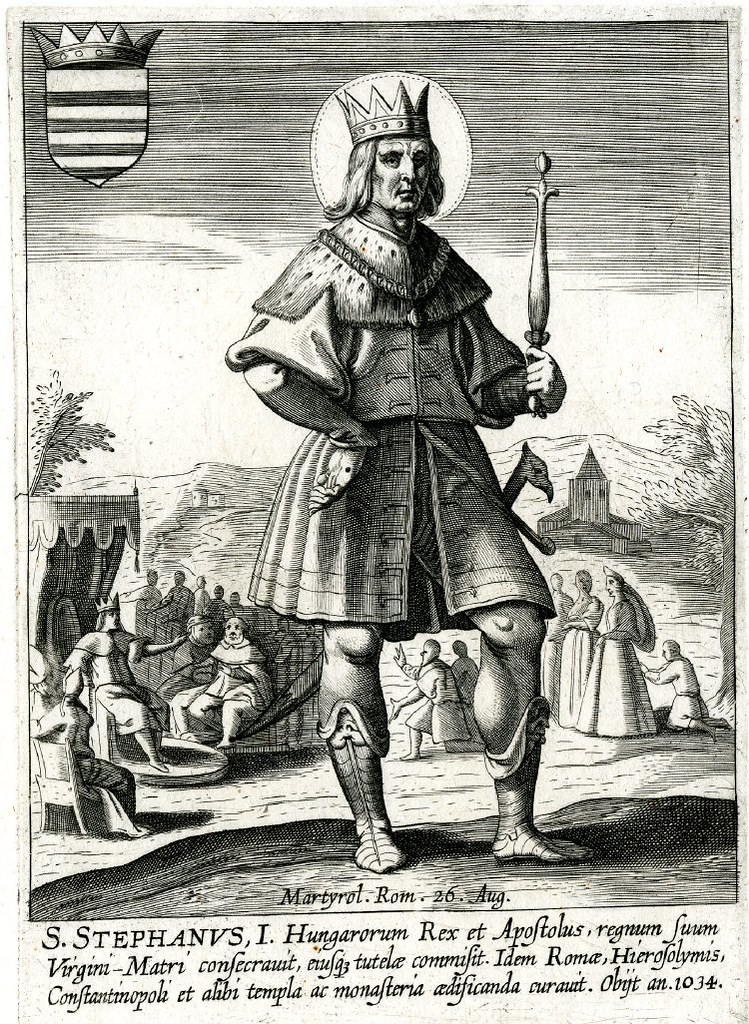
1. Michiel Snyders, “Engraving of St. Stephen, King of Hungary” in Aubert le Mire’s Sanctorum Principum … Imagines, Flemish, 1613.
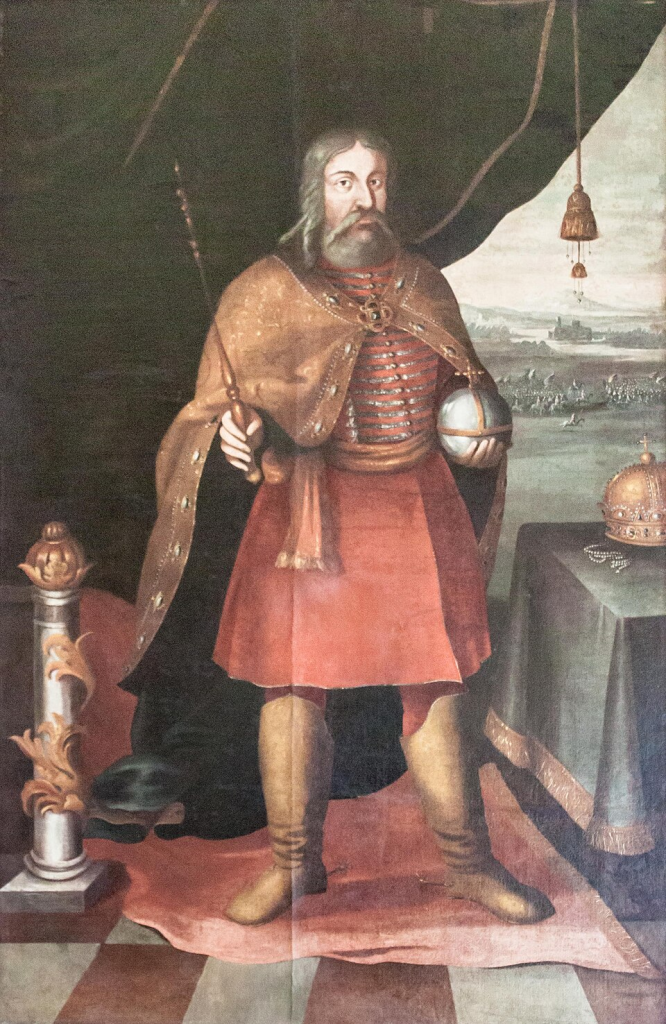
2. Unknown, “St. Stephen, King of Hungary,” Hungary, 17th century.
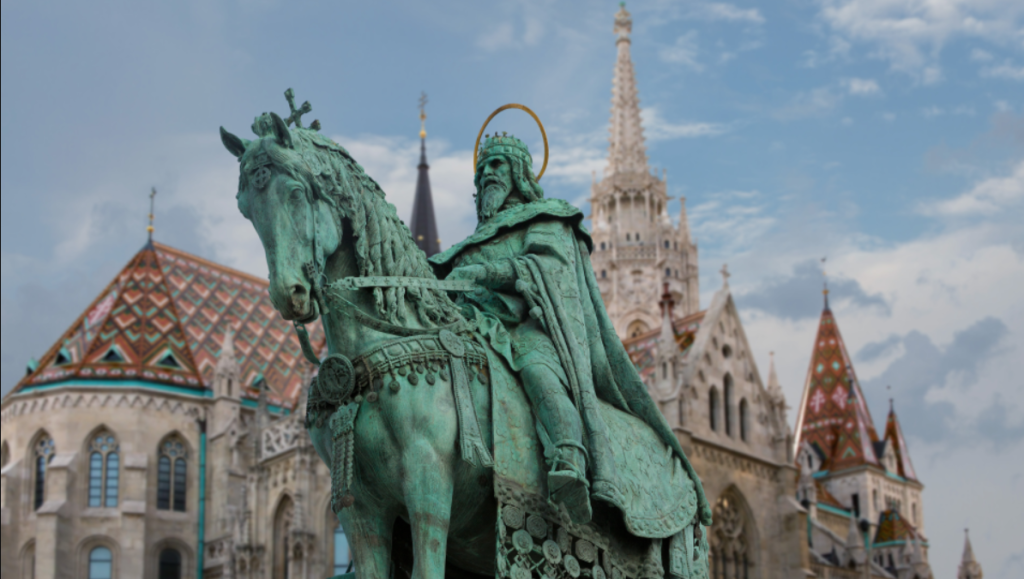
3. Alajos Stróbl, “Statue of St Stephen in front of Matthias Church, Budapest,” Hungary, 1906.