
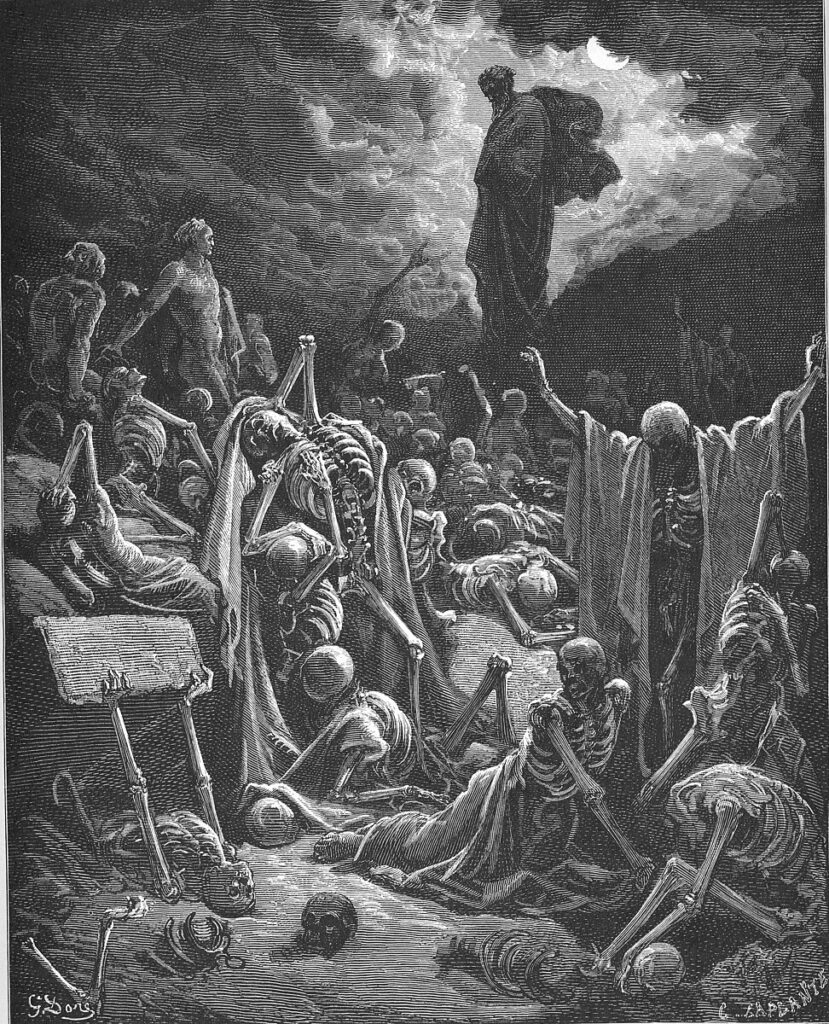
The Lutheran Church remembers and gives thanks to God for the prophet Ezekiel on July 21st. There is much to the prophet’s story that he relays to us in the book bearing his name, a book that is just shy of forty chapters and noted for its challenge to theologians and translators who face the difficult Hebrew text. Ezekiel himself was a rarity, both a prophet and a priest.
From visions to action prophesies, the theme of Ezekiel is that Judah’s fall is coming, but a new day will dawn when God will establish a new and everlasting covenant with his people and build up a new Jerusalem.
The book of Ezekiel opens with his first prophesy in the year 593, a message that comes at a critical time in the history of God’s people. Israel was divided long ago into two separate kingdoms: the northern kingdom of Israel and the southern kingdom of Judah, where Jerusalem was located. By this time, Israel has already fallen to Assyria, but Judah remains. It is Ezekiel’s task to prophesy to the house of Judah that her own end is coming and that the Jerusalem Temple will fall.
After years of Judah’s idolatry and unfaithfulness, Jerusalem indeed falls in the year 587. The people are exiled to Babylon, but Ezekiel’s message continues, this time with a promise and new hope. In the year 573 Ezekiel prophesies about the new Jerusalem, including the Good Shepherd who will save the people. Dry bones will be resurrected, and a new water will wash over the people, all prophesies in which Christians have rejoiced as they’ve seen them fulfilled in their Lord, Jesus the Christ! Even though Ezekiel’s prophesies come true in a dim and immediate sense for Judah, who returns from exile in the year 538, the true restoration is coming, the kingdoms will be united, and the reign of the new Son of David will never end.
The book concludes with Ezekiel’s vision of the new Temple with God’s many specifications of cubits, furnishings, and chambers. We will hear of this Temple again again many years later from the pen of St. John the Divine, who records in the book of Revelation the Temple in the new Jerusalem out of which also flows a river of living water.
Brief History
Ezekiel’s prophesies have held a special place in the hearts of Christians for millennia. More specifically, his vision of the valley of dry bones has been cherished as a powerful image of the resurrection that is often read at the Easter Vigil, the climax of the liturgical year.
Other parts of Ezekiel, however, have understandably not been as frequently utilized, such as the portions that are particularly disturbing or subject to potential theological misinterpretation. According to St. Jerome, only those who had reached the age of thirty were permitted to read the beginning and ending of Ezekiel’s book for fear that it might cause more misunderstanding than sound teaching.
Luther’s commentary on the prophet’s message highlights the importance of understanding the new Temple not as the promise of a physical building one day in Jerusalem but as the one who is the new Jerusalem and new Temple, “so this building is nothing else than the kingdom of Christ, the holy church or Christendom here on earth until the last day.”
Collect
O Almighty God, who hast knit together Thine elect in one communion and fellowship in the mystical body of Thy Son Jesus Christ, our Lord: grant us grace so to follow Thy blessed saints in all virtuous and godly living, that we may come to the unspeakable joys which Thou hast prepared for those who unfeignedly love Thee; through the same, Jesus Christ, Thy Son, our Lord, who liveth and reigneth with Thee and the Holy Ghost: ever one God, world without end. Amen.

Lessons
Resources

Issues, Etc. interview with the Rev. Dr. Charles Gieschen on Ezekiel and the Book of Revelation
Propers found in Daily Divine Service Book: A Lutheran Daily Missal, edited by the Rev. Heath Curtis
References:
1. The Lutheran Study Bible: English Standard Version, ed. Edward A. Engelbrecht et al. Concordia Publishing House. 2009.
Images:
1. Ezekiel’s Vision of the Valley of Dry Bones, Gustave Doré, French, 1866.
2. Ezekiel’s Vision, Raphael, Italy, 1518.
3. Ezekiel’s Vision, Giorgio Ghisi after Giovanni Battista Bertani, Italy, 1554.