

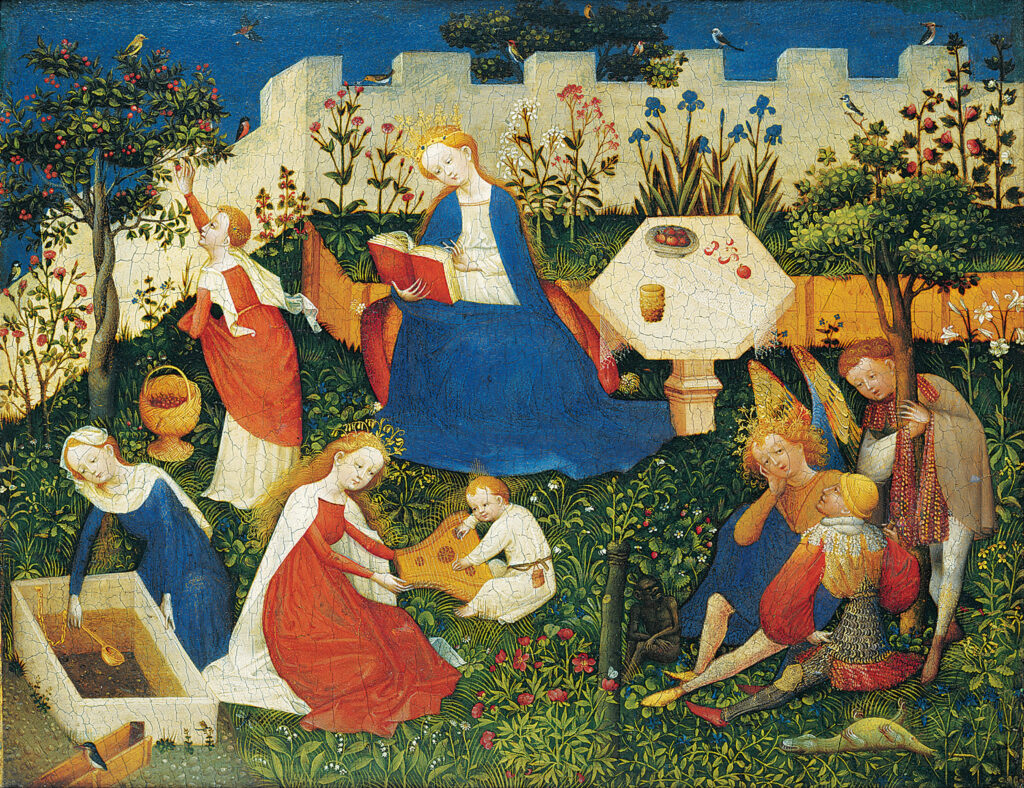
History
As we’ve written elsewhere, including here on the blog and for the Lutheran Witness, the feast of the Dormition of St. Mary is certainly a high point of the summer portion of the Church calendar. It is worthy of note since the day on which the Church remembers the Virgin Mary falling asleep in the Lord on August 15th has many traditions and much symbolism associated with it. In Germany, it is known as Kräutertag, or “spice day,” a reference that nods to the custom of families bringing bundles of herbs to the church to be blessed. Such an association reminds Christians of the tradition that when Mary died, beautiful flowers and the smell of fragrant spices filled her tomb.
In fact, many flowers and plants have long been associated with the story of salvation, used by Christians to help teach the stories of Jesus and Mary and let the Gospel sink into the hearts and minds of people during largely pre-literate Middle Ages. The devotional practice of planting for and cultivating these plants in a special garden called a “Mary Garden” has continued from at least the seventh century up until today, with the gardens planted in honor of this saint and other figures in the Passion story meant to pay homage to the greatest story ever told. No matter whether these gardens fill one flower pot or are entire botanical gardens set aside for reflective prayer, they provide a place of rest and meditation where one can ponder the virtues of the Virgin Mary, remember the gift that this beloved saint is to the Church, and urge Christians to think about how we also might mirror St. Mary’s piety and obedience in our own faith walk.
Indeed, gardens can offer a dim reflection of the original truth, beauty, and goodness present in the first garden and help remind us of the paradise from which we came and that we will one again day enjoy—the promise of eternal life that we have with Jesus after death. Look to Scripture, and you’ll find countless examples of how gardens are charged with theological meaning. The Garden of Eden is where God first walked with man, and the Garden of Gethsemane is likewise where Jesus wept and submitted to the Father’s will. For Christians, the garden is a place of encounter.
In many ways, gardening itself is an act of faith, more than just a seasonal pastime or an aesthetic hobby, instead serving as a living metaphor of the posture that we take towards God. Gardening and enjoying gardens invites Christians into deep contemplation offering a place where patience, trust, attentiveness, anticipation—including belief in the hidden work of God even when nothing is visible—can be nourished and cultivated. We cannot make our gardens grow, we can only tend to them faithfully (Matthew 13 and Corinthians 3:6-7).
St. Mary Garden
So what exactly goes into making a Mary Garden? The only “essential” elements that you must have, if you will, are flowers chosen for their Christian spiritual significance. If you didn’t know, many flowers have been named for Jesus, Mary, the angels, holy spaces, etc. In fact, there are so many of these flowers that you can plant an entire garden focused on specific aspects of Jesus’ and Mary’s lives such as his Passion. See an extensive list below that offers just a sampling of some of our favorite “Mary” flora and their references. Please note that beyond these there are many, many more that are traditionally thought of as Marian plants but that we haven’t taken the time to include.
When planning your garden, no matter how large or how small, first think through what you will plant in your garden and what the most appropriate plants for your space are. As there are hundreds of Marian plants, climate, soil, and light need not be an obstacle for your planting. Don’t get so wrapped up in the symbolism of the flowers that you forget what kind of environment your plants need to thrive!
Similarly, think about the maintenance needed for your plants. If you’re a beginning gardener, you might want to intentionally choose hardy plants and not something finicky. If you want your garden to continue to grow year after year, plant perennials rather than annuals. We personally love the idea of starting with perennials and adding in some new annuals every year to keep the garden fresh and growing anew.
Lastly, consider the timing of the blooming. We love planning our Mary gardens so that something is always blooming, no matter if it is spring, summer, or fall.
Indeed, there are many ways to think through what plants can be included in your Mary Garden. The use of blue or purple flowers such as irises or lavender will gesture to the traditional colors associated with this saint. Fragrant herbs reflect both her spiritual sweetness as well as her bitter sorrows. The use of any type of rose will remind Christians of Mary’s characteristics as both delicate and strong, fragrant and thorned, and the way that her own life was filled with both joy and sorrow, beauty and suffering. Finally, the use of any plants named after her will make direct reference (i.e. rosemary or marigolds).
Also be sure to consider ways to make your garden peaceful enough that it is a place where you and others can spend considerable time in prayer and reflection. Think about adding a bench or seating that offers a place for quiet contemplation. Windchimes or a fountain can make for a relaxing soundscape and block out extraneous noise. And a fire pit can help you enjoy it at night, when things get cooler, and in celebration of other liturgical days such as the Nativity of St. John and Pentecost. Of course, use your creativity and think of other ways that you can make it a place where you can regularly go to for deep devotion, as well!
With all these things in mind, we hope that you find the list of flora below helpful in curating your Mary Garden and that this space might help you further ponder this saint and St. Mary’s role in the salvation story—may your liturgically-themed garden be a site where you can engage in rhythmic, seasonal, and faithful prayer.
| Common Name Today | Medieval Name and/or Religious Meaning |
| Amaryllis | Has the medieval name of “Beautiful Lady” or St. Joseph’s Lady” as “amaryllis” comes from the Greek amarysso, meaning to “sparkle” or “shine,” evoking the image of a radiant woman |
| Aster | Known as “Michaelmas Daisy” as it blooms in late September and its fresh color and vigor at the close of the growing season makes it a fitting symbol of hope and spiritual triumph |
| Baby’s Breath | Also known as “Lady’s Veil” as its fine, white, and mist-like flowers resemble a delicate lace veil, calling to mind Mary’s humility and purity |
| Bleeding Heart | Makes reference to the sorrow and symbolic bleeding of Mary’s heart as she watched her Savior die |
| Carnation | Its name reminds one of the Incarnation of Christ and it has been long thought of as a symbol of the Crucifixion as German legend says they bloomed at both his Nativity and death |
| Chrysanthemum | The flower of All Saints’ as they are associated with death and used to adorn graves. They are said to have been present when Christ was laid in the tomb |
| Clematis | Thought to symbolize the cross, clinging to a wooden trellis or crossbeam and exhibiting a star-shaped bloom that has been compared to the positioning of the five wounds of Christ |
| Columbine | Known as “Our Lady’s Shoes” and said to have sprung up under Mary’s feet as she visited Elizabeth at the Visitation |
| Daffodil | Remembered as “Mary’s Star” as its six-pointed bloom and bright, golden, and eye-catching nature remind viewers of the Star of Bethlehem that heralded Christ’s birth |
| Edelweiss | A symbol of purity due to its soft, white, wooly petals |
| Easter Lily | Long a symbol of the Resurrection |
| English Holly | Remembered as the “Burning Bush” as its striking red berries and deep green, spiny leaves symbolically and visually recall the biblical burning bush where God revealed himself to Moses. It is also associated with Advent and Christmas, celebrating the Incarnation |
| Forget-me-not | Also called the “Eyes of Mary,” which reminds us that when Mary looked at Jesus through a mother’s eyes, she saw God face-to-face, reminding us to keep our own eyes on Christ |
| Iris | White iris is thought to symbolize virginity and purple iris, royalty |
| Lady’s Mantle | Its soft, scalloped leaves resemble the folds of a protective cloak or mantle, symbolizing shelter, mercy, and spiritual covering, reminding Christians of the headcovering that St. Mary is also depicted as wearing |
| Lady’s Slipper | Associated with Mary walking in obedience and service and the events in her life that required her to follow God while on journey, such as her Visitation to St. Elizabeth or the flight into Egypt |
| Lavendar | Its calming and relaxing scent evokes Mary’s gentle spirit while its blue-purple color recalls the traditional hue associated with her in art |
| Lily-of-the-Valley | Represents Mary’s tears, and legend says that when Mary wept at the foot of the cross, these white flowers appeared |
| Madonna Lilly | Also known as the “Annunciation Lily.” The St. Venerable Bede described the white petals as symbols of Mary’s body. The Archangel Gabriel is often depicted in Christian art as presenting Mary with the lily at the Annunciation. In Scripture lilies have long been associated with Solomon’s Temple (I Kings 7:19-22), and Christ himself commented on their beauty (Luke 12:27). |
| Marigold | “Mary’s Gold,” reminding us of the heavenly crown that all saints receive in heaven |
| Mary’s Thistle | Also known as “milk thistle” but named for the Virgin Mary in reference to her mothering of Jesus. |
| Morning Glory | This flower opens each day with the sun, closes by afternoon, symbolizing new beginnings, faithfulness, and obedient blooming in God’s light as well as Mary’s vigilance and daily readiness to serve God |
| Ox-Eye Daisy | Called “Mary’s star” and associated with the Star of Bethlehem that led the Magi to Christ |
| Pansy | Its three petals have long been referenced as a “Trinity flower” |
| Passion Flower | Its five stamens symbolize the five wounds of Christ |
| Poinsettia | Known as the “Nativity Flower” or “Christmas Star” |
| Rose | Various roses and their colors have long been associated with various aspects of Mary (i.e. white, Mary’s purity; red, Mary’s sorrow and the blood of Christ as well as Christ’s martyrdom; and gold, Mary’s glory). Mary has also long been associated with roses with her life being characterized as both delicate and strong, fragrant and thorned. |
| Rosemary | A combination of “Mary” and “Rose,” bringing together two important aspects of Marian flora |
| Rose of Jericho | This desert plant survives in a curled up, dormant, brown, dessicated state for years, then opens up and turns green with a bit of water. It is known as a Resurrection Plant |
| Scotch Thistle | Known as “Judas’ Cloak” |
| Shamrock | St. Patrick used this in his teachings as a representative symbol of the Trinity, with each leaf representing a Divine Person while the plant remains one plant |
| Snowdrop | Known as “Candlemas Bells” and are believed to have bloomed at Candlemas, when Mary brought Jesus to the temple for his presentation |
| Star-of-Bethlehem | Symbolizing the star that led the Magi to Christ |
| St. John’s Wort | Remembered as a symbol of St. John the Baptist and his pointing to Christ, traditionally harvested on his late-June day |
| Violets | In Christian flower symbolism violets became known as the “flower of humility.” Again, their deep purple color is traditionally associated with penitence, mourning, and royalty. |
Images:
1. Upper Rhenish Master, The little Garden of Paradise, 1450.



Dear Special Angels you are.. thank you for your blessing ,as always, in your loving posts. Since my son Erick’s passing from neglect in a group home setting I have pondered the living God in all of this unexpected passing. I am gaining more steady understanding in that all of God ‘s children are pure in heart from the beginning.. it is choices during their lives that make their stories go askew. If someone is working for a pay check only in a group home setting they do not belong there at all. They need to find more appropriate jobs that stir their hearts and their love of living. It is not person I am after in this court case.. it is the person’s actions that have led to this most horrible passing of Erick. So I feel I need to cultivate Love for the people who were on from June 1-3 and rebuke their actions of neglect as the sin they do have to deal with somehow . I have yet to hear from my attorneys , and that is what I need for closure and my own peace. I managed to go intoTarget yesterday .. I had avoided it as it was the last place on Mondey the first of June I saw my son alive… and so happy.. but hot in the high heat of the day. I regret not going in after taking him to the door of the group home. it might have made a difference I do not know…but he wanted to rest and I talked to him later that night.. he was resting they would not wake him… On Tuesday he called saying he had congestion and wanted ME to talk to Roger the director that day….. I did we both as well as other staff were not at peace when Roger was on .. ever….. Roger took it lightly saying he was fine… and gave him a Tylenol.. That is sthe last time I heard my son’s voice…. weds the cold call came he had passed on like it was nothing to Roger at all who calle dme…. the rest has been God directed activity for me.. emptying out his room alone… and yet I have heard him directing me in that too……. So.. I have all of his beautiful collections.. but not him.. and his message to me is that in his fear of Roger and all there with the way they shamed him a writer, artist and avid man of Buddhist peace and non judgment…. he is telling me these figures of Marvel and Star Wars and Star Trek through the years are his friends.. and that he loves how I am boxing them in their right boxes and bagging each one labwling all of it in honor ot a fine man a peaceful warrior. So I am here healing now in the Mary Garden you have posted to help me find my way to peace and rejoice in the fact he no longer is shamed.. dishonored or feels judged. WOW… a blessing you are… I have a photo my neighbor took of him with his sash over his one eye as he wore it to remind him not to ever. I will try to send it and a link to Four Horsemen Studios too honoring Erick with a figure of himself.. Four Horsemen from the Bible in Revelation who run their company on the eithics and love of God.. Good vs Evil in all their stories and figures. I will email you the link to the show they did on Erick. it is so beautiful and I love you for helping me maintain balance in this situation and finding more peace . Love from Merrilyn Mc Elderry and son Erick.. grateful for you and all you do with such Love.